
A Damaged Shipment Needs One Claim-and-Replacement Decision Before Three Teams Make Three Promises
A damaged shipment claim and replacement decision helps a seller preserve proof, choose a customer remedy, file the carrier claim, and prevent duplicate promises.
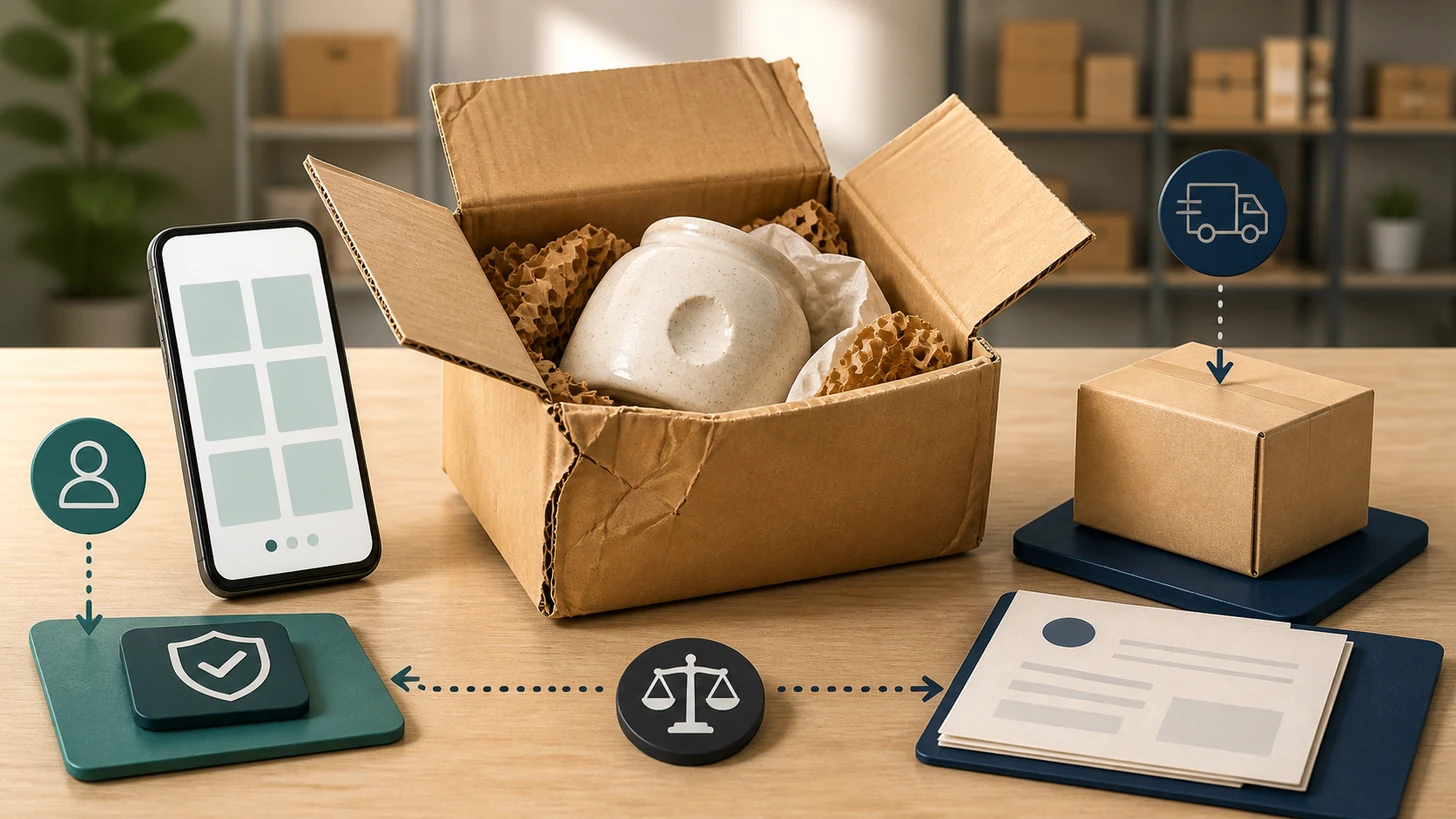
The customer remedy and the carrier claim are connected, but they are not the same decision or the same clock.
A damaged shipment claim and replacement decision should start with customer safety, the order and tracking record, structured photos of the outer package, label, inner packing, and damaged item, plus instructions to retain the item and packaging when the carrier may inspect them. Then choose the customer remedy under your policy and marketplace obligations without waiting blindly for a carrier claim. Record who can refund, replace, request a return, or offer another remedy so support, fulfillment, and finance do not make overlapping promises.
The Damaged Shipment Claim + Replacement Decision Kit is the primary paid next step when customer care, fulfillment, carrier claims, inventory, and finance need one case record. It adds editable intake, proof, decision, customer, claim, inventory, recovery, and prevention controls behind this free workflow.
Run two clocks from one case file
| Clock | Decision to control | Evidence to preserve |
|---|---|---|
| Customer clock | When the customer receives an acknowledgment, safety direction, remedy decision, and next update. | Customer report, item condition, order promise, policy, marketplace rules, communications, and remedy approval. |
| Carrier clock | Who may file, the claim or inspection deadline, required documents, packaging retention, and response dates. | Tracking, shipment record, packaging photos, damage photos, value proof, repair or salvage information, and claim confirmation. |
| Inventory clock | Whether a replacement is available, reserved, shipped, returned, quarantined, repaired, or written off. | SKU, serial or lot if relevant, stock movement, replacement order, return receipt, and disposition. |
| Cash clock | Refund, replacement cost, shipping, carrier recovery, deductible or limit, tax, and final loss. | Original sale, cost basis, refund, replacement expense, claim amount, payment, and closeout entry. |
FedEx's current damage-claim guidance says a claim may need the tracking number and supporting proof such as package photos or a receipt, and instructs claimants to keep the original packaging until the claim is resolved because an inspection may be required. UPS likewise directs claimants to upload supporting documents to prove damage. Carrier terms, eligible claimant, filing windows, inspections, limits, and documents vary by service, contract, route, and shipment.
Choose the customer remedy with a decision table
| Situation | Likely operating path | Control before promising |
|---|---|---|
| Unsafe, leaking, sharp, electrical, food, chemical, or otherwise hazardous condition | Give safety-first stop-use and handling direction, then escalate the remedy. | Do not ask the customer to ship, handle, or dispose of the item until the approved safety process is clear. |
| Clear damage, replacement in stock, customer wants the product | Reserve and release one replacement under the approval rule. | Record the original item disposition, duplicate-shipment guard, and claim evidence before stock moves. |
| Clear damage, no replacement or customer no longer wants it | Use the approved refund, return, repair, or allowance path. | Confirm marketplace, payment, tax, contract, and return rules. |
| Proof incomplete but the report is plausible | Ask for the smallest missing proof set and give a specific decision time. | Do not turn evidence collection into an accusation or an indefinite delay. |
| High value, repeated pattern, fraud signal, regulated item, or disputed condition | Escalate to the authorized reviewer while customer updates continue. | Keep neutral language and preserve evidence; do not allege fraud without proof. |
Support offers a refund, the warehouse ships a replacement, finance files a different claim amount, and no one knows what happened to the damaged item.
A case owner controls the customer remedy, stock movement, claim evidence, carrier deadline, recovery, and final loss.
Copy this damaged-shipment decision row
Damage case control row
Order, customer, SKU, quantity, and shipment: [details]
Report date and customer-decision deadline: [dates]
Safety concern and instruction: [none / details]
Tracking, delivery event, and carrier service: [details]
Outer package, label, inner packing, and item photos: [received / missing]
Item, package, and packing retained for inspection: [status]
Product value, cost, shipping, and replacement availability: [details]
Customer preference and policy lane: [details]
Approved remedy: [refund / replacement / return / repair / allowance / other]
Approver and promise timestamp: [details]
Replacement order, refund, or return reference: [details]
Eligible claimant and carrier filing deadline: [verified facts]
Claim documents, amount, confirmation, and status: [details]
Carrier payment and final business loss: [details]
Damage cause tag and prevention action: [details]
Case owner and closeout reviewer: [names]
Use a customer response that protects both clocks
I am sorry your order arrived damaged. First, please stop using or handling it if [safety condition] applies. To help us choose the right resolution and document the shipment, please send [smallest needed photo list] and keep the item, box, label, and packing materials for now. We will review this by [specific time] and confirm one next step: [replacement, refund, return, repair, or other available paths]. You do not need to wait for us to finish a carrier claim before we give you the promised customer decision.
Get the free Emergency Triage Sheet
The first three moves for any business emergency, plus one practical fix in your inbox each week.
No spam. Unsubscribe anytime.
Worked example: replace now, claim separately
A hypothetical lighting shop receives a report that a $240 fixture arrived with a cracked shade. The customer sends the outer-box, label, inner-packing, full-item, and close-up photos. There is no electrical damage, and a replacement shade is in stock. The support lead records the customer decision time, reserves one shade, and gets the authorized replacement approved.
The warehouse ships the replacement against the case reference instead of creating an unlinked courtesy order. The claims owner retains the photos, invoice, tracking, packaging details, and replacement cost, verifies the carrier's filing requirements, submits the claim, and logs the confirmation. Finance closes the case only after the carrier decision and replacement cost are reconciled. The customer did not have to wait for the carrier, and the business did not lose the claim trail.
Use this simple loss formula
Net damage loss = customer refund + replacement product cost + extra freight + return, repair, disposal, and handling cost - carrier recovery - salvage or resale recovery.
Track customer value separately from accounting loss. A fast, fair remedy can be correct even when the carrier later denies or limits the claim. The formula makes the operating cost visible without turning the customer conversation into a claims negotiation.
Damaged shipment checklist
- Give safety-first instructions where the condition could cause harm.
- Acknowledge the customer and set one decision or update time.
- Save the order, policy, marketplace, tracking, delivery, and carrier-service facts.
- Request only the photos needed to prove package, packing, item, and shipment identity.
- Tell the customer whether the item and packaging must be retained.
- Confirm who is eligible to file and the carrier's current deadline and requirements.
- Choose one remedy through the authorized policy and record the promise.
- Link every refund, replacement, return, repair, or allowance to the case.
- Submit and track the carrier claim independently from the customer promise.
- Reconcile inventory, carrier recovery, and net loss before closeout.
- Tag the cause and assign a packaging, handling, supplier, warehouse, or carrier prevention action.
FAQ: should the customer wait for the carrier claim?
Do not automatically make the customer wait. The merchant's policy, marketplace rules, consumer obligations, evidence, risk, and available remedy should control the customer decision. The carrier claim is the business's recovery lane. Set a customer deadline you can keep, and escalate unusual cases rather than promising an outcome you cannot authorize.
Connect photos, claims, and replacement controls
Use the customer-friendly damage photo request when proof is still incomplete. If tracking shows delivery but the package cannot be found, use the separate delivered-but-not-received proof file. Damage, loss, theft, wrong item, and return-condition disputes need different evidence and decisions.
Free version vs. full kit
This article gives you the free version: four-clock map, remedy table, control row, customer script, worked example, loss formula, and checklist. Use it when one owner can control a straightforward case.
The paid Damaged Shipment Claim + Replacement Decision Kit adds editable safety, intake, photo, decision, customer, inventory, carrier-claim, recovery, accounting, cause, and closeout tools. The All-Access membership is the broader option for recurring fulfillment, returns, marketplace, payment, and customer-response problems. This is operational education, not legal, insurance, carrier, safety, tax, or financial advice, and no claim payment or customer outcome is guaranteed.
Fix the next one before it starts.
Join the list for the free Emergency Triage Sheet and a new practical fix every week.
No spam. Unsubscribe anytime.