
A Customer Slip-and-Fall Needs Care, Scene Control, Evidence, and Insurer Notice
A customer slip-and-fall incident response checklist helps a small business protect the person, secure the hazard, preserve evidence, notify insurance, and control communications.
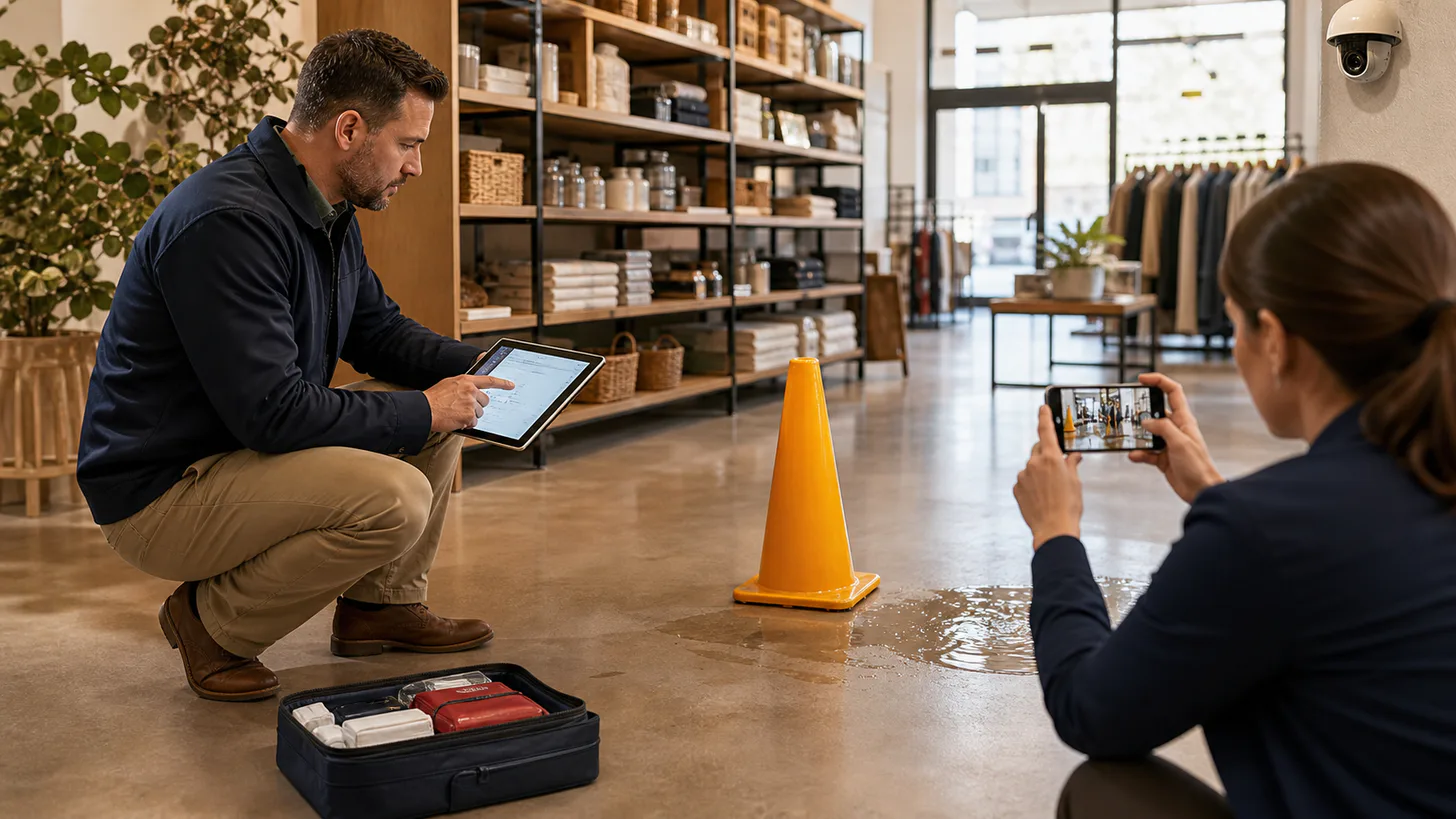
The first response should protect the person and prevent another fall; the second should preserve an accurate scene record and notify the right insurance contact without guessing fault.
After a customer slip-and-fall, address immediate medical and safety needs, call emergency services when appropriate, secure the hazard so no one else is hurt, and assign one manager to document the scene. Preserve surveillance video before it overwrites, photograph the area from several angles, record witness contact details and factual observations separately, save inspection and cleaning records, and notify the insurer or broker promptly under the policy instructions.
Do not argue about fault, ask the person to sign a release, promise payment or coverage, edit the incident report later, stage a reenactment, or post footage or opinions. A fall is an occurrence to document and route, not a claim outcome to decide at the counter.
The Customer Slip and Fall Incident Insurance Response Kit adds editable incident, witness, evidence, insurer-notice, and follow-up controls for a response involving several employees or records.
Separate the first 10 minutes from the next 24 hours
| Window | Operational priority | Proof to keep |
|---|---|---|
| First minutes | Check immediate safety, request appropriate medical help, protect privacy, and keep others away from the hazard. | Time, responders, assistance offered, hazard-control action, and who took charge. |
| Before the scene changes | Photograph and video the area, lighting, approaches, warning devices, floor condition, nearby objects, and relevant weather or entry conditions. | Original files, capture times, device or custodian, and a note explaining unavoidable changes made for safety. |
| Same shift | Preserve surveillance, POS and access context, inspection and cleaning logs, schedules, maintenance records, and separate witness accounts. | Native exports, retention hold, witness contacts, source list, and missing-record note. |
| Policy notice | Follow the policy, broker, or carrier instructions and report the factual occurrence without deciding liability. | Notice copy, claim or reference number, transmission proof, assigned contact, and next request. |
| Follow-up | Respond through one authorized contact, preserve new communications, complete corrective safety work, and cooperate as required. | Communication log, repair or cleaning proof, insurer instructions, demand or suit routing, and closure status. |
The Insurance Information Institute's small-business claim guidance uses a customer fall as an example of an occurrence that should be reported and says to provide event specifics and witness contacts. Your policy language and insurer instructions control your actual duties, so confirm the route and timing rather than relying on a generic checklist.
Use neutral facts in the incident record
Use the person's own words where important, but do not turn a conversation into a medical diagnosis. Record visible conditions without declaring that a surface was safe, dangerous, wet for a specific duration, or the cause of the fall unless reliable evidence establishes it.
Staff clean first, debate fault, trade opinions in chat, and discover later that the video overwrote.
Staff provide care, secure the hazard, preserve originals, record neutral facts, and save insurer notice proof.
Copy this incident chronology row
Customer fall control row
Location and event time: [exact place and time]
First employee notified and time: [name and time]
Immediate condition observed: [neutral description]
Assistance offered or requested: [facts only]
Emergency services: [requested / declined / unknown; time]
Hazard-control action and time: [barrier / cleanup / shutdown / other]
Scene photos and video: [custodian and file link]
Surveillance sources and retention window: [systems and owner]
Video preservation completed: [time, export, custodian]
Witnesses: [names, contact, separate statements]
Customer statement: [attributed facts or declined]
Inspection, cleaning, maintenance, weather, delivery, and staffing records: [links]
Changes made after the event: [what, why, when, by whom]
Policy, broker, or carrier notice: [time, channel, proof, reference]
Demand, attorney contact, or lawsuit received: [no / details and routing time]
Corrective safety action: [owner, due date, proof]
Open requests and response owner: [items]
Preserve originals and work from copies. If surveillance has a short overwrite cycle, export the relevant time range plus reasonable lead-in and follow-through, document the system clock, and record who handled the file. Do not crop away context or rely only on a phone recording of a monitor when a native export is available.
Give staff a script that is caring without deciding liability
I'm sorry this happened. Your immediate safety is our priority. Would you like us to call emergency services or contact someone for you? We are securing the area and documenting what occurred. I will record your contact information and the facts you want us to have, and our authorized contact will handle any follow-up. I cannot make decisions about fault, coverage, or payment here, but I will make sure the incident is routed promptly.
Adapt the language to the person's condition and the emergency. Do not prioritize a form over care, pressure anyone to decline assistance, seek a medical release, or condition basic help on a statement.
Worked example: a fall near a cooler
A hypothetical neighborhood shop employee hears a customer fall near a refrigerated case. The employee calls the manager, offers emergency assistance, moves other shoppers away, and places a barrier without first wiping the area. The manager photographs the aisle, case, floor, lighting, approaches, and barrier; records that a small clear liquid area was visible without guessing its source or duration; and preserves the camera view plus the prior hour before the system's nightly overwrite.
A second employee writes a separate statement. The manager saves that day's inspection log, cooler maintenance ticket, staffing schedule, and nearby transaction time, then reports the occurrence through the broker's instructed channel and stores the confirmation. Maintenance fixes a verified drain issue later that day, and the manager documents the repair without changing the original report. The example organizes response work; it does not determine fault, causation, injury, coverage, or damages.
Get the free Emergency Triage Sheet
The first three moves for any business emergency, plus one practical fix in your inbox each week.
No spam. Unsubscribe anytime.
Connect the occurrence to the wider insurance file
Use the business insurance emergency guide to map the policy, broker, carrier, affected operations, and notice proof. If the carrier later denies or limits the claim, the business insurance claim denial response helps map each reason to policy language and evidence. For a customer demand that reaches systems, footage, or private records, keep any data-breach response on its own legal and technical track.
Customer slip-and-fall incident checklist
- Address immediate medical and safety needs; call emergency services when appropriate.
- Protect the person's privacy and keep bystanders away from the hazard.
- Assign one manager to the incident chronology and one authorized external contact.
- Photograph and video the scene before avoidable changes, while making necessary safety changes promptly.
- Preserve native surveillance, system-clock context, and enough lead-in and follow-through.
- Collect witness contact details and separate factual accounts without coordinating stories.
- Save inspection, cleaning, maintenance, staffing, delivery, weather, transaction, and prior-complaint records that may be relevant.
- Record customer statements accurately without diagnosing injury or deciding causation.
- Notify the insurer or broker through the policy's instructed route and save proof.
- Route any demand, attorney letter, lawsuit, subpoena, regulator contact, or police request immediately.
- Complete corrective safety work and preserve before-and-after proof without rewriting history.
- Keep footage, photos, medical details, and personal information restricted to authorized people.
FAQ: should the business clean the area before taking photos?
Preventing another injury comes first. When it is safe and does not delay necessary care or hazard control, capture the scene promptly. If conditions must change immediately, document what changed, why, when, and by whom; never leave a known hazard exposed merely to preserve a picture.
FAQ: should an employee apologize?
Employees can show concern and offer help without making conclusions. Avoid arguments, blame, promises, coverage statements, or admissions about facts the employee does not know. Train staff to route follow-up to one authorized person.
FAQ: what if the customer refuses an incident report?
Do not force a signature. Record that information or a statement was offered and declined, document the business's own observations and actions, preserve other evidence, and follow the insurance notice process.
Free version vs. full kit
This article gives you the free version: the response windows, fact model, chronology row, staff script, worked example, and checklist. Use it for a straightforward occurrence when the team can preserve the scene, notify the policy contact, and keep one clean record.
The paid Customer Slip and Fall Incident Insurance Response Kit adds editable incident, witness, evidence, insurer-notice, communications, and follow-up controls. The All-Access membership includes the broader kit library while membership is active. This content is operational education, not legal, medical, insurance, or claims advice.
Fix the next one before it starts.
Join the list for the free Emergency Triage Sheet and a new practical fix every week.
No spam. Unsubscribe anytime.