
An Insurance Cancellation Notice Needs a Reinstatement Plan Before Coverage Drops and Customers Feel It
An insurance cancellation notice response plan helps small businesses verify the reason, protect the deadline, and coordinate reinstatement before operations are exposed.
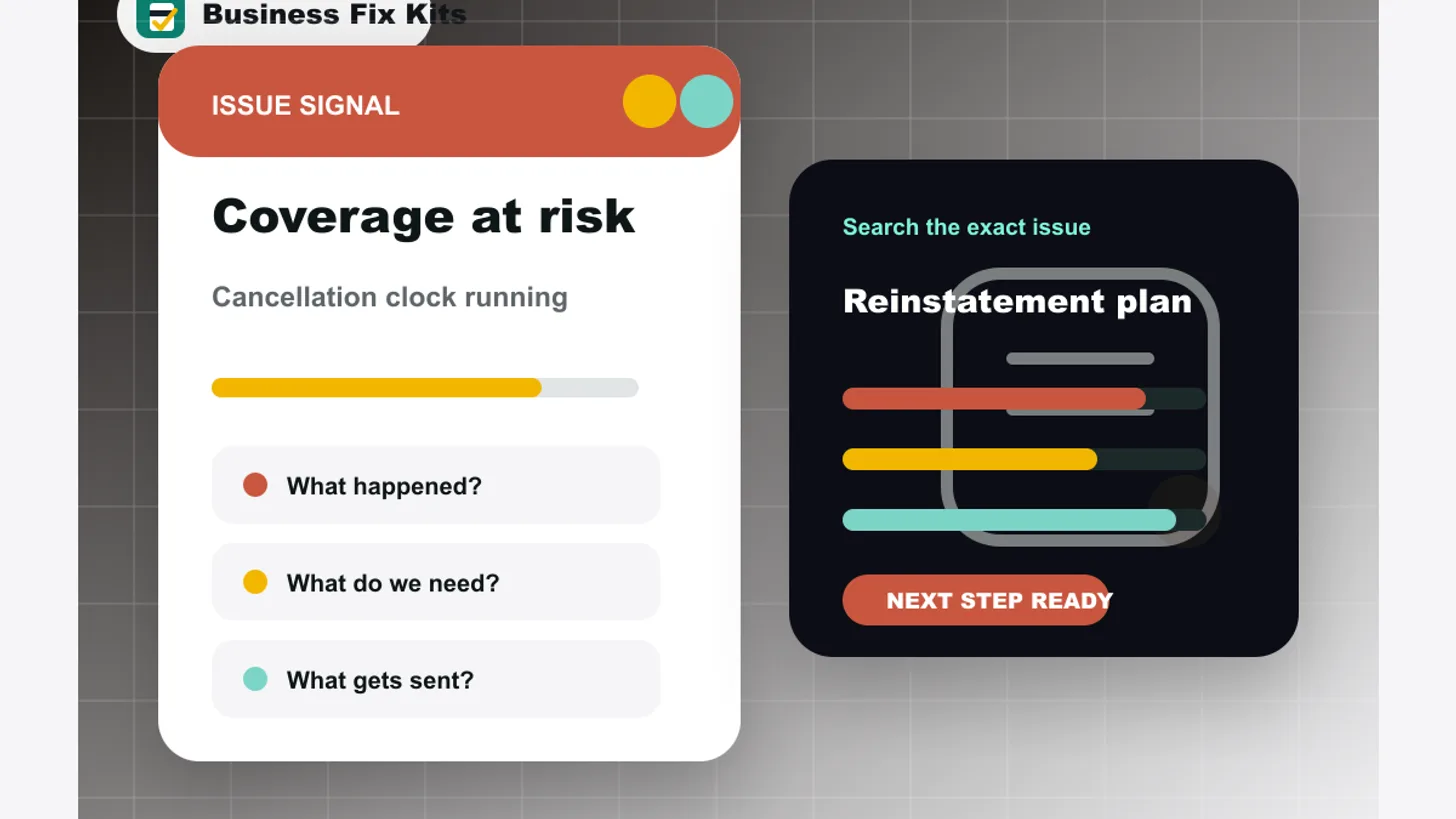
A cancellation notice is not only a paperwork issue. It is an operating-risk issue.
An insurance cancellation notice response should verify the reason for cancellation, confirm the effective date, gather the policy and billing records, and document the reinstatement path before the business assumes coverage is still active. Small businesses get blindsided when they treat the notice as a reminder instead of a deadline.
Sometimes the issue is as simple as a payment failure or missing form. Sometimes it is underwriting or exposure-related. Either way, the business needs one owner and one record so the path back to active coverage is visible.
Start with the broader business insurance emergency response plan when the notice also affects vehicles, active jobs, leases, certificates, claims, or other coverage dependencies.
What the notice may be telling you
| Cancellation reason | What it often means | What to gather first |
|---|---|---|
| Non-payment | Premium did not process or the balance is still open. | Billing history and payment proof. |
| Missing underwriting info | The carrier still needs documents or answers. | Prior emails, forms requested, and contact notes. |
| Exposure or eligibility issue | The carrier sees a risk mismatch that may need re-quoting or explanation. | Policy file, operations detail, and broker communication. |
| Administrative lapse | A renewal or endorsement step may be incomplete. | Renewal timeline and current declarations page. |
The four-part reinstatement file
Why this turns into a bigger problem fast
Assume the broker is working on it, keep operating normally, and realize later no one saved written proof of active coverage.
Log the notice, confirm the reason, fix the issue, and wait for written proof of reinstatement before calling the matter closed.
Get the free Emergency Triage Sheet
The first three moves for any business emergency, plus one practical fix in your inbox each week.
No spam. Unsubscribe anytime.
A broker or carrier follow-up script
We received the cancellation notice for policy [number] effective [date]. Please confirm the exact reason for cancellation, the steps required for reinstatement or replacement coverage, and the written proof we should expect once the issue is resolved. We are gathering all billing and policy records now and want one clear checklist to avoid delays.
Small business example
A contractor receives a cancellation notice for general liability coverage because a payment failed after a card update. The owner assumes the broker will fix it in time. A stronger move is to verify the effective cancellation date, identify which jobs and certificates depend on active coverage, send proof of payment or updated billing immediately, and request written reinstatement confirmation before crews keep operating as usual.
Checklist before you treat the issue as fixed
- Confirm the effective cancellation date and the exact reason listed.
- Identify customers, vehicles, jobs, or landlords that depend on active coverage.
- Keep billing proof, carrier emails, and policy documents in one file.
- Ask for written confirmation of reinstatement or replacement coverage.
- Update anyone waiting on proof of insurance once the policy status is restored.
FAQ: is paying the balance enough to assume coverage is active again?
Not always. Payment may be one step, but the business still needs written confirmation that the policy is reinstated or replacement coverage is bound. Until then, do not assume the exposure is closed.
Free version vs. full kit
The free version is straightforward: confirm the reason, fix the issue, and insist on written proof. The full Business Insurance Cancellation and Reinstatement Kit adds notice trackers, broker follow-up prompts, dependency checklists, and proof-of-coverage logs for handling coverage interruptions without guessing.
View the Business Insurance Cancellation and Reinstatement Kit
Fix the next one before it starts.
Join the list for the free Emergency Triage Sheet and a new practical fix every week.
No spam. Unsubscribe anytime.