
A Failed Payment Recovery Sequence Should Do More Than Send a Receipt Error
A failed payment recovery sequence helps small businesses collect missed renewals with better timing, clearer messaging, and fewer accidental cancellations.
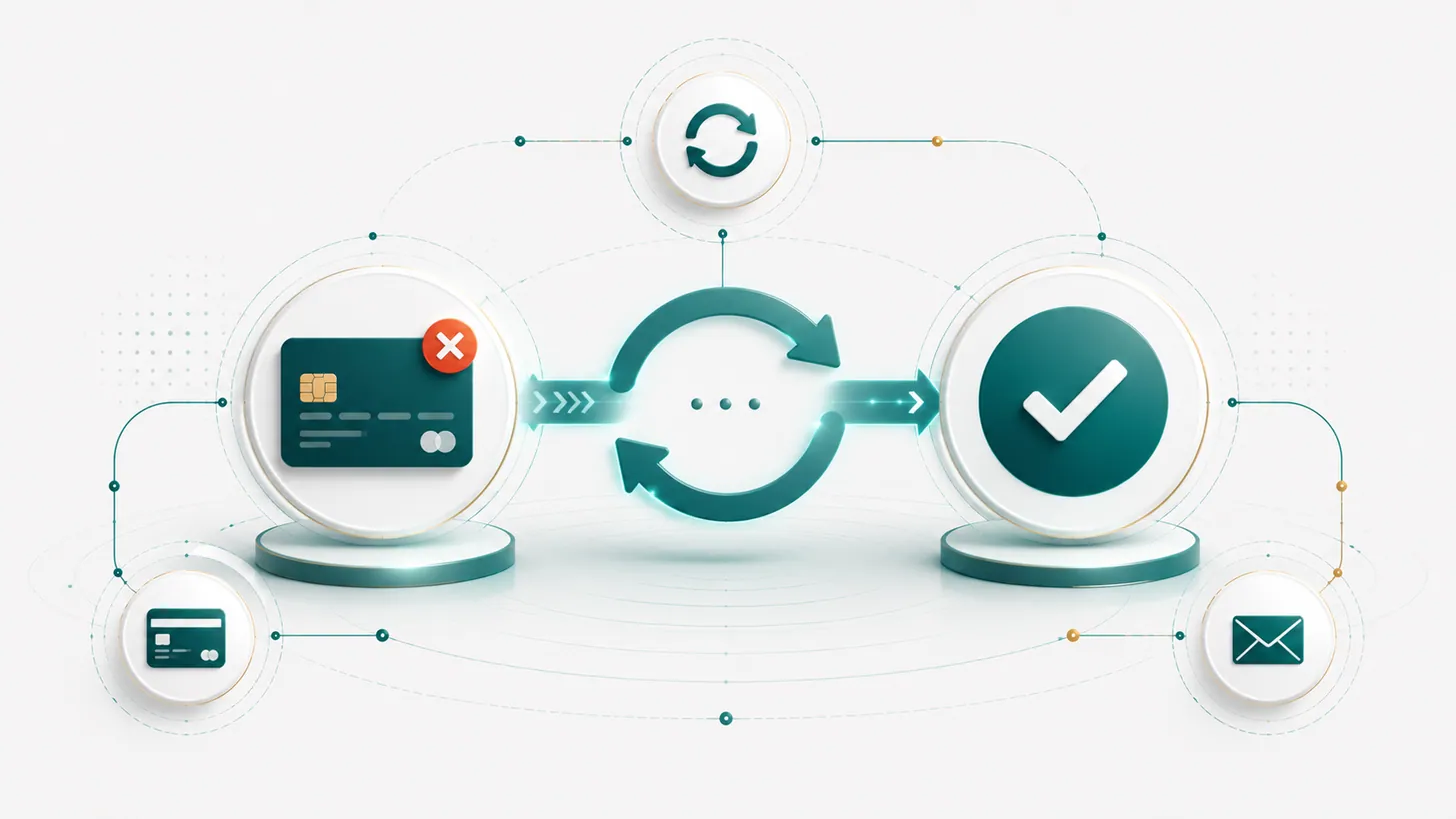
One failed charge should start a sequence, not a shrug.
A failed payment recovery process should retry intelligently, notify the customer clearly, and tell them what to do next before the account or order breaks. A generic card-declined email is rarely enough to recover meaningful revenue.
Part of the complete guide: Failed Payment Recovery: Dunning Playbook
Subscription businesses, retainers, service plans, memberships, and installment offers all suffer when failed payments are handled inconsistently. The money leaks in small amounts until churn and support noise make it obvious.
Where failed payment recovery breaks down
- The customer only gets a processor-generated alert with no business context.
- No one knows whether the account is being retried automatically.
- The message asks the customer to fix the problem but does not link to the place to update payment.
- Service continues indefinitely even after multiple failures.
- Support, billing, and operations use different rules.
The four-message recovery ladder
| Stage | Goal | Best tone |
|---|---|---|
| Initial failure | Notify quickly and make payment update easy. | Helpful |
| Retry window | Remind before the next retry or service impact. | Clear |
| Final warning | Name the deadline and consequence. | Firm |
| Service pause | Explain what changed and how to restore service. | Documented |
Your payment failed. Please try again.
Your renewal did not go through. Update your payment method here by [date] to keep service active without interruption.
A customer recovery script
Hi [Name], we were unable to process the payment for [service or order]. To keep everything active, please update your payment method here: [link]. We will retry the charge on [date]. If you need help, reply here before then and we will point you to the fastest fix.
Get the free Emergency Triage Sheet
The first three moves for any business emergency, plus one practical fix in your inbox each week.
No spam. Unsubscribe anytime.
Definition: what is dunning in a small business context?
Dunning is the sequence of reminders, retries, and account rules used to recover failed or overdue recurring payments. For a small business, that usually means better email timing, a cleaner update link, and a documented pause policy before revenue drips away.
Small business example
A monthly maintenance plan fails because the card on file expired. If the business only relies on the payment processor alert, the customer may miss it. A stronger system sends a branded notice, retries three days later, warns before service pauses, and gives the customer a direct payment-update link every time.
Recovery checklist
- Set a retry schedule and write it down.
- Use branded messages that explain the service impact.
- Link directly to the payment update path.
- Coordinate billing and service pause rules.
- Track recovery rate by message stage.
Related dunning guide
For the full recovery system, use the failed payment recovery dunning playbook to connect retries, email timing, service pause rules, and win-back messages.
Free version vs. full kit
The free version is simple: retry on purpose, notify clearly, and define the pause point. The full Failed Payment Dunning Recovery Kit gives you message sequences, retry timing guidance, service-pause scripts, and a recovery tracker for recurring revenue operations.
View the Failed Payment Dunning Recovery Kit
Related article: How to Follow Up on a Late Invoice Without Burning the Relationship
Fix the next one before it starts.
Join the list for the free Emergency Triage Sheet and a new practical fix every week.
No spam. Unsubscribe anytime.