
A Contractor License Board Complaint Needs a Response Packet Before the Story Gets Written Without You
A contractor license board complaint response plan helps small businesses gather facts, organize evidence, and answer cleanly before a state complaint turns into a bigger risk.
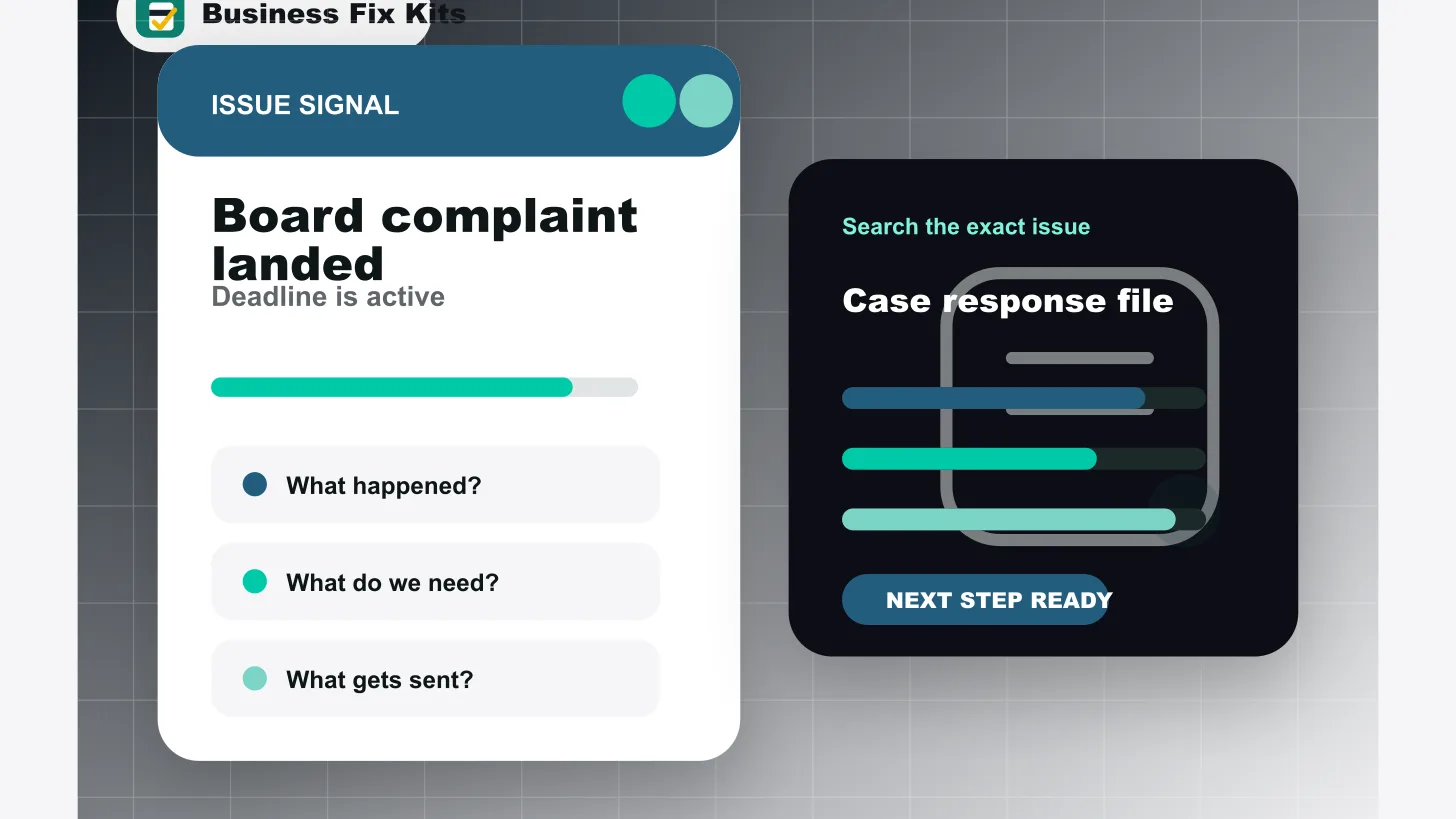
A contractor license board complaint is a documentation problem before it is a persuasion problem because the regulator first wants a clean record of what happened and when.
A contractor license board complaint response should identify the exact allegations, gather the full job file, build a dated timeline, and answer each point with documents before anyone starts arguing the case in email or by phone. Small businesses weaken their position when they reply from memory instead of from the project record.
Many owners make one of two bad moves. They either fire off a defensive response the same day, or they avoid the notice because they assume the customer is just venting. The stronger move is to treat the complaint like a regulated intake process with a deadline, evidence file, and a point-by-point reply.
Rules vary by state, so verify with your attorney before you rely on any complaint response in a live licensing matter. That check matters most when the notice includes allegations tied to workmanship standards, permit duties, contract disclosures, or restitution demands.
What a board complaint usually asks you to prove
| Complaint issue | What the board wants to see | What you need first |
|---|---|---|
| Scope or quality dispute | What was promised versus what was delivered. | Signed contract, plans, photos, and change orders. |
| Payment dispute | What was invoiced, collected, and still open. | Invoice ledger and proof of payments. |
| Delay allegation | Why the schedule moved and how it was communicated. | Timeline, messages, and delay notices. |
| Licensing or permit issue | Whether the work was performed under the right authority. | License details, permit records, and subcontractor information. |
The four pieces of a useful response packet
Why rushed complaint responses backfire
Argue about the customer, blame the weather, and attach random screenshots without tying them to the complaint points.
Identify each allegation, cite the dated project record, and keep the reply factual enough that a regulator can follow it quickly.
Get the free Emergency Triage Sheet
The first three moves for any business emergency, plus one practical fix in your inbox each week.
No spam. Unsubscribe anytime.
A complaint response paragraph you can copy
We received the complaint notice dated [date] regarding project [name/address]. We checked the contract, change records, payment history, and project communications. Our response to each allegation is summarized below and supported by the attached documents labeled Exhibit A through Exhibit [x]. We are submitting this response in good faith and will provide any additional documents the board requests.
Small business example
A remodeler receives a complaint claiming abandoned work, overbilling, and unapproved changes on a $24,000 kitchen project. The owner knows the story is more complicated, but memory alone is not enough. The stronger move is to pull the signed scope, the two approved change orders, the payment ledger showing $18,500 collected, site photos from each week, and the text thread where the homeowner paused access for nine days before drafting the reply.
That packet should also explain the sequence cleanly instead of assuming the board will connect the dots. A one-page timeline that shows contract date, deposit received, change-order dates, access delays, and the final communication before the complaint can lower confusion fast. If a document hurts your position, it still belongs in the file because hiding it usually creates a bigger credibility problem later.
Checklist before you submit to the board
- Match every allegation to one dated answer and one supporting document set.
- Use the contract version and change records that were actually signed, not draft copies.
- Organize exhibits in the same order the complaint raises issues.
- Remove emotional commentary that does not help a regulator verify facts.
- Confirm with the right attorney or licensing professional if state-specific exposure is unclear.
FAQ: should you call the complainant before sending your response?
You can try to resolve the customer issue, but do not let informal conversations replace the written record the board requested. If you do speak with the complainant, document what was discussed and continue preparing the response packet anyway.
That is also why the response should stay narrow and dated. The board usually cares less about who sounds angriest and more about whether the contractor can show a contract path, a communication path, and a fact pattern that can be checked quickly.
If the business cannot explain the job in order, that usually signals the packet is still incomplete.
Free version vs. full kit
This article gives you the lightweight version: build the file, organize the timeline, and answer each allegation with evidence. The full Contractor License Board Complaint Response Kit gives you a board-response organizer, exhibit log, allegation-by-allegation worksheet, and submission checklist for high-pressure complaint deadlines. It is designed for contractors who need one defensible packet instead of a rushed pile of screenshots and memory-based explanations.
View the Contractor License Board Complaint Response Kit
Related article: Scope Creep Gets Expensive When the Change Order System Lives Only in Your Head.
Fix the next one before it starts.
Join the list for the free Emergency Triage Sheet and a new practical fix every week.
No spam. Unsubscribe anytime.