
A Stop-Work Order Needs a Response Packet Before the Job Site Sits Still Too Long
A stop-work order response checklist helps small businesses organize documents, clarify the violation, and restart work faster with a clean correction path.
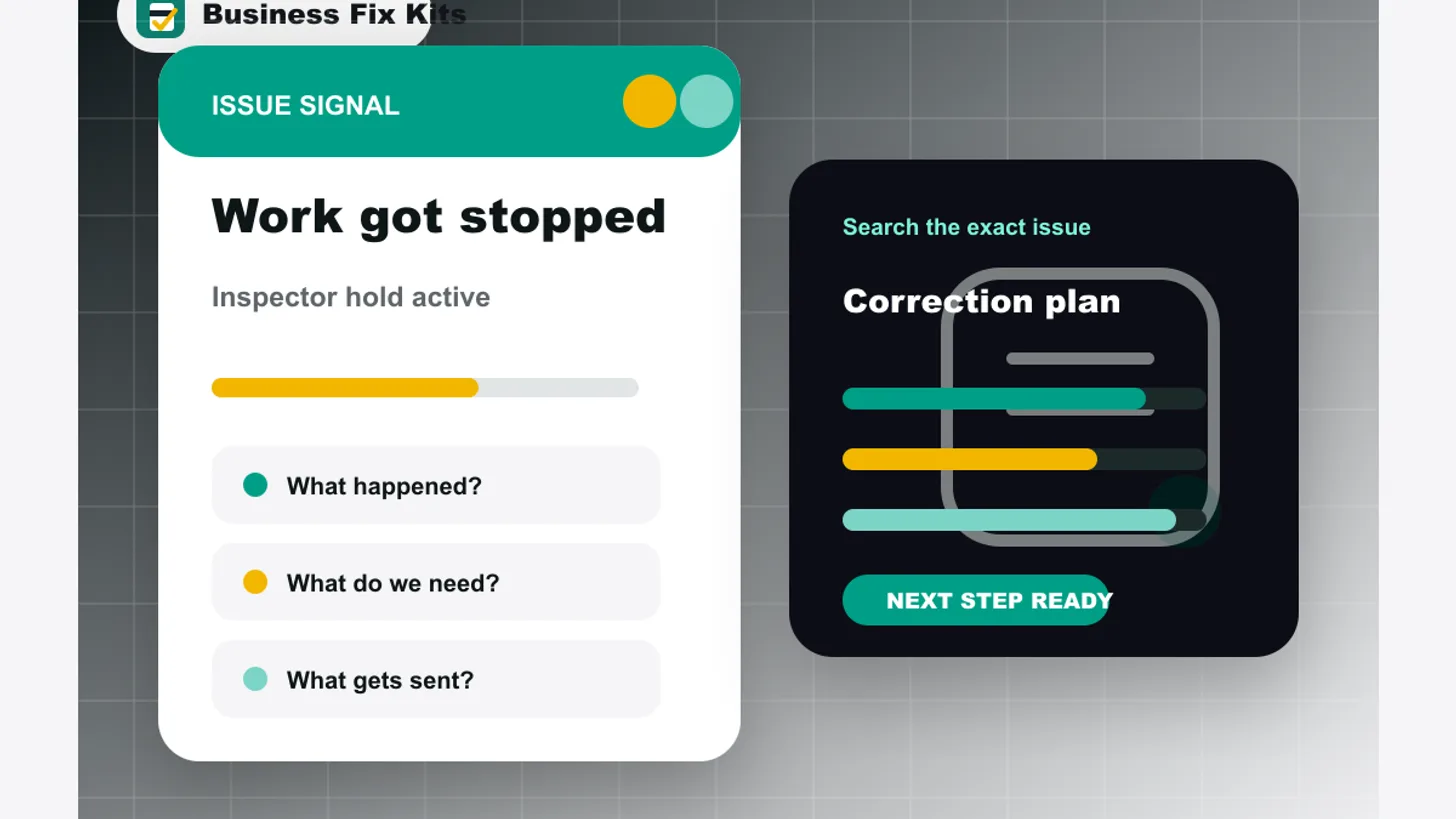
The job does not restart because people are upset. It restarts when the correction path is documented.
A stop-work order response should identify the exact violation, gather the permit and inspection record, assign corrective actions, and log who owns each next step before anyone argues with the inspector or promises a restart date. Small businesses lose time when the team treats the notice like a general complaint instead of a specific correction list.
The fastest restart usually comes from organization, not bravado. The more clearly the business can show what happened, what is fixed, and what still needs approval, the faster the conversation can move from conflict to compliance.
What belongs in the response packet
| Packet section | Why it matters | Typical contents |
|---|---|---|
| Notice summary | Keeps everyone aligned on the actual issue. | Stop-work order, date posted, site address, inspector name. |
| Permit file | Shows approved scope and permit history. | Permit copy, approved plans, prior inspections. |
| Correction log | Turns the violation into assigned tasks. | Issue, owner, due date, status, evidence. |
| Restart request | Makes reinspection or review easier to process. | Completed items, photos, and request date. |
The four-step site response framework
Why site teams lose days after the notice
Argue on the spot, leave the crew guessing, and restart correction work without one shared list.
Log the violation, align it to permit records, assign corrections, and track the restart request through one packet.
Get the free Emergency Triage Sheet
The first three moves for any business emergency, plus one practical fix in your inbox each week.
No spam. Unsubscribe anytime.
A project-manager script for the owner or field lead
We received a stop-work order at [site] on [date]. Before any restart request goes out, we need one response packet with the notice, permit documents, correction items, assigned owners, and photo proof for each completed fix. Please route all updates through this packet so the reinspection request is clean.
Small business example
A remodel contractor is stopped for permit-related scope confusion and one unapproved field change. The team can lose two more days just debating what the inspector meant. A stronger move is to pull the approved plans, identify the exact mismatch, photograph the existing condition, assign the correction work, and submit the reinspection request with the corrected record instead of a rushed explanation.
Checklist before requesting restart
- Use the stop-work order language, not memory, when logging the issue.
- Attach the permit and the latest approved plan set.
- Assign each correction item to one owner with one due date.
- Capture photo or document proof for each completed fix.
- Request reinspection only after the packet tells a complete story.
FAQ: should the crew keep working on other tasks?
Only within whatever limits the notice and applicable rules allow. The key is to avoid drifting into more untracked work while the stop-work issue is unresolved. Separate approved work from prohibited work clearly.
Free version vs. full kit
This article covers the free version: identify the violation, build the packet, and track the correction-to-restart path. The full Building Permit Stop-Work Order Response Kit adds correction logs, restart-request templates, crew communication prompts, and documentation checklists for getting the site moving again faster.
View the Building Permit Stop-Work Order Response Kit
Related article: Scope Creep Usually Gets Expensive Before the Team Admits It Is Happening.
Fix the next one before it starts.
Join the list for the free Emergency Triage Sheet and a new practical fix every week.
No spam. Unsubscribe anytime.